

Brushed steel shelf: choosing finish, function, and maintenance
Brushed vs. polished: how the surface performs in everyday life
The choice between brushed and polished steel determines how a shelf behaves in light, how easily it conceals traces of use, and how demanding it is to maintain. A brushed surface has a directional satin grain that dampens reflection, camouflages small scratches, and feels calm in everyday life. A polished, mirror-like finish delivers maximum brightness and sharper contours, but shows fingerprints and micro-scratches more quickly. According to Rapid Protos, the mechanical post-treatment not only changes the appearance; it also affects the nearest surface structure, which is why proper post-cleaning and passivation are important for durability (rapid-protos.com).
- Light and spatial effect: brushed reads matte and soft, polished reads clear and light-enhancing
- Traces of use: brushed hides small scratches and everyday marks, polished highlights them
- Tactility: brushed feels drier and more grippy, polished is smooth
- Cleaning: brushed tolerates routine wiping with less visible streaks, polished requires softer cloths and more dry wiping
In a room with many hard surfaces, a brushed steel shelf reduces glare and balances textures. If a more graphic, reflective expression is desired, a polished surface can function as an active light source, provided one accepts higher maintenance.
The material behind the finish: steel quality, grit, and passivation
Stainless steel resists corrosion because a chromium-rich, passive oxide film forms on the surface. The quality of the alloy is important; in most homes, AISI 304 is fully sufficient, while AISI 316, alloyed with molybdenum, is recommended in coastal or chloride-stressed environments where so-called "teastaining" occurs more frequently. The mechanical after-finish also plays a role. Brushing to a #4-satin (typically 150–220 grit) creates the familiar, linear grain, but at the same time removes the original passive film and can, if performed uncritically, embed particles from tools. Therefore, thorough post-cleaning and re-passivation is good practice, especially for shelves in intensive use or near the coast.
In Danish metal craftsmanship, quality often lies in the transition between process steps: hand brushing, edge treatment, and repassivation per item result in a more uniform tone and fewer blurring marks than mass production. Historically, the close connection between designer and workshop has been a strength in Danish furniture production, as described in the ResearchGate article Networks, Narratives and New Markets on the emergence of Danish Modern; small series and finish control provide robust details and longer lifespan (researchgate.net).
The Skagen shelf in use
Skagen is our wall-mounted shelf in stainless steel, brushed to a calm, directional grain. In use, it reflects what proper brushing can achieve: the surface reads evenly, scratch tolerance is high in daily use, and light is distributed without harsh reflections. The detail study below shows a single Skagen shelf, where a vintage bowl in polished steel acts as a counterpoint. The warm, angled lighting gathers in the polished bowl, while the shelf's brushed backplate remains balanced; a clear demonstration of how two steel finishes can interact in the same setup. Fittings and screws are not visible, providing clean lines where the shelf's depth and load capacity appear without technical clutter. Edges are gently rounded, so handling and wiping feel controlled, and the profile appears slim without losing stability.
See more specifications for Skagen on the product page at Acier Studio: Skagen steel shelf.
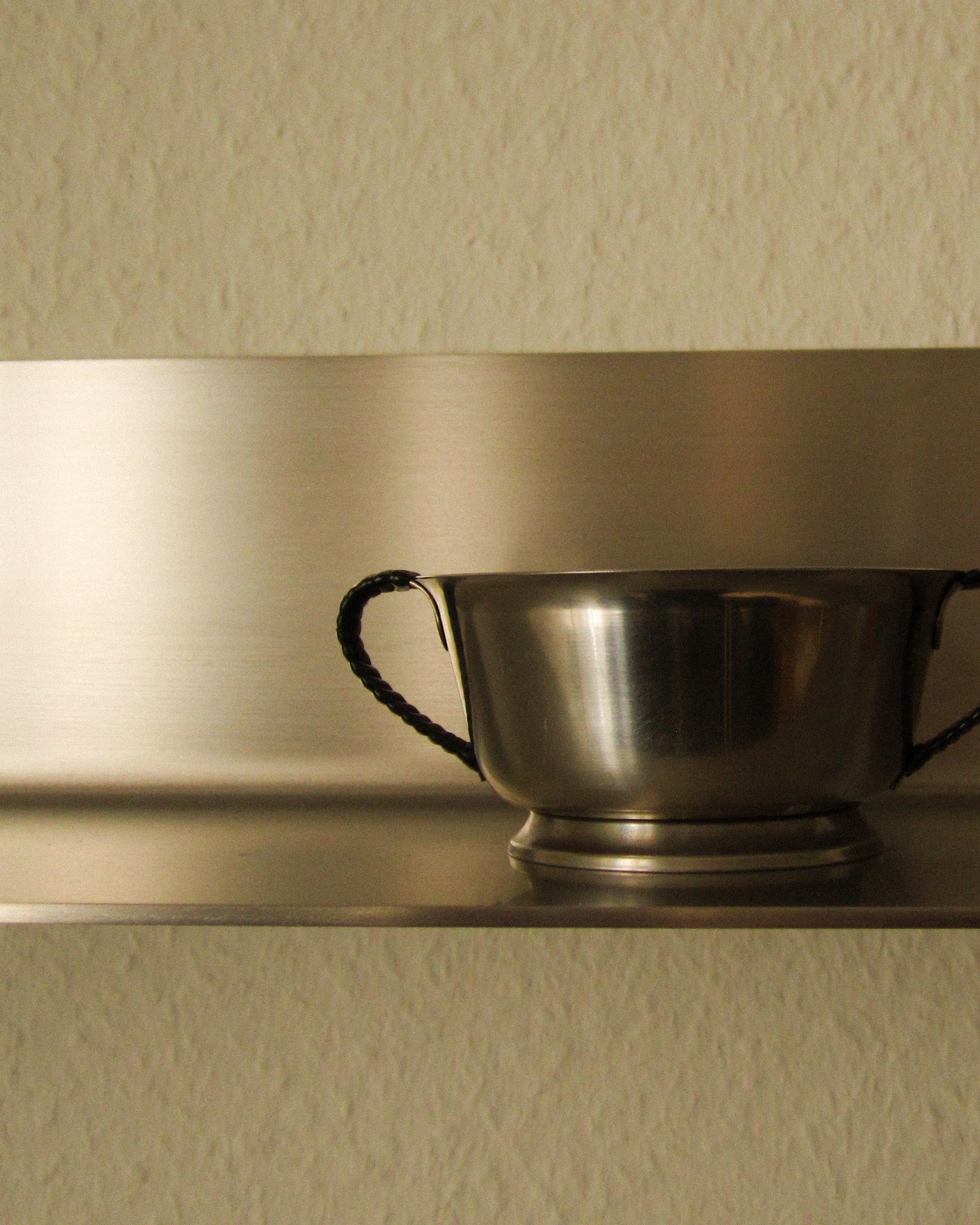
In Aarhus, the shelf is refined in small batches; brushing is performed with a consistent grain direction across the entire surface, visible edges are worked, and each item is cleaned and passivated before packing. This ensures that the surface arrives stable and ready for use in the home.
Interior design: scale, depth, and material encounters
A brushed steel shelf benefits from being placed in dialogue with warmer materials. Oak, walnut, and natural stone add tactility that balances the steel's coolness, while textured textiles dampen acoustics and light reflection. Cocolapine Design often points out that consistency in material direction creates calm; let the grain direction in brushed steel run consistently on a wall surface, so the eye reads one direction instead of visual noise (cocolapinedesign.com). Stick to one metal finish per field of view, especially in smaller rooms where too many metallic nuances can break up the overall impression. Consider shelf depth in relation to wall thickness and access conditions, so the steel's line remains light, even when the shelf is loaded.
Maintenance, cleaning, and honest patina
Clean brushed steel in the direction of the grain with a soft microfiber cloth, lukewarm water, and a neutral, pH-balanced cleaning agent. Rinse with clean water and wipe dry to prevent limescale stains. Avoid chlorine-containing agents, steel wool, and other ferromagnetic abrasives that can leave particles and start discoloration. Euro Inox's guide to stainless steel care recommends mild agents, frequent wiping in demanding environments, and careful rinsing after stronger cleaners, if used exceptionally (doczz.net/doc/4666375/cleaning-stainless-steel).
Polished surfaces require softer cloths and less pressure; micro-scratches are more visible. If you get limescale spots, a mild solution of vinegar can be used locally, followed by thorough rinsing and drying. In coastal environments, frequent freshwater rinsing helps limit teastaining; consider AISI 316 for exposed locations. Should a brushed shelf get a deeper scratch, controlled re-brushing with 180–220 grit in the original direction can help; always finish with thorough cleaning and passivation. Polished surfaces should be professionally re-polished to avoid wavy reflections.
Long-term, a brushed steel shelf will develop a calm patina of use rather than sharp damage, if maintained correctly. The right alloy for the location, a consistent grain direction, and careful finishing in the workshop create a surface that withstands everyday life without losing its expression. In a Danish context, where small-scale production and finish control are highly valued, this lays the groundwork for furniture that lasts for decades and patinas with integrity rather than deteriorating.

