

Styling open steel kitchen shelves with intention
Function first: placement, load, and spacing
Open shelving works when reach, weight, and rhythm align. Place the items you use daily at eye to chest height, with the heaviest and most handled objects nearest the body’s natural reach. On a fixed wall shelf, keep mass toward the wall line rather than at the outer edge; this reduces cantilevered stress and visual bulk. Distribute weight evenly left to right to keep the composition balanced and to respect the anchors behind the shelf. If the wall allows, mount into studs or use high-quality anchors rated for the substrate; masonry, plaster, and drywall behave differently under load.
Spacing is not decoration; it is legibility. Leave consistent negative space around each grouping and maintain a horizontal datum where possible. A practical rule is to aim for roughly one third open space per shelf run so items can breathe and so cleaning is viable. Align object tops in quiet runs—glassware, jars—then introduce one vertical accent to break monotony. Avoid deep stacks that drift beyond the front edge; anything projecting forward will read as clutter and invites knocks in a working kitchen.
Pairing brushed steel with oak and ceramic
Brushed stainless has a linear grain that diffuses highlights and softens reflections. It reads as calm rather than mirror-bright, which makes it cooperative with natural materials. Oak contributes fiber, pattern, and warmth; ceramics add mass, tactility, and edge control.
- Brushed steel: directional grain, mid reflectance, neutral-cool undertone
- Oak, oiled or lightly smoked: open grain, low reflectance, warm undertone
- Ceramic, matte or satin glazed: microtexture, low to mid reflectance, color-stable
Let oak cutting boards or trays act as “bases” that contain small utensils or condiments; this prevents micro-objects from scattering visually across a steel plane. Use ceramic vases, pitchers, or lidded jars to introduce volume that counters the shelf’s thin profile. Keep finishes honest: oiled oak will darken slightly over time, which pairs well with the steady tone of steel; matte glazes stop glare under task lighting and make the brush lines in the shelf finish more apparent rather than competing with them.
How brushed steel reads in warm and cool palettes
Lighting decides how stainless is perceived. Under warm sources near 2700 K, brushed steel shifts toward a softened graphite with amber reflections; under cooler sources around 4000 K, it appears cleaner and slightly bluer. In a warm kitchen—terracotta tiles, ochre pottery, oiled oak—brushed steel becomes the neutral anchor that prevents the scene from feeling heavy. In a cool palette—white walls, light greys, pale stone—it provides definition without the severity of polished metal.
Balance is straightforward. If walls and counters are cool, introduce one or two warm ceramic tones to bridge the temperature gap. If the room is materially warm, let glass and clear bottles help the shelf read lighter while the steel keeps lines crisp. Avoid mixing too many metal tones on a single run; if brass is present in handles or a tap, keep it to one or two accents so the stainless has visual authority and the palette remains coherent.
Skagen: a wall-mounted shelf that respects the working kitchen
The Skagen wall-mounted stainless steel shelf is designed for practical display above sinks and prep zones, where splash, steam, and frequent handling are routine. The brushed finish carries a fine, linear grain that hides minor scuffs and fingerprints better than polished surfaces. The profile is visually slim yet robust; folded edges present a clean line and give the sheet inherent stiffness without visual weight.
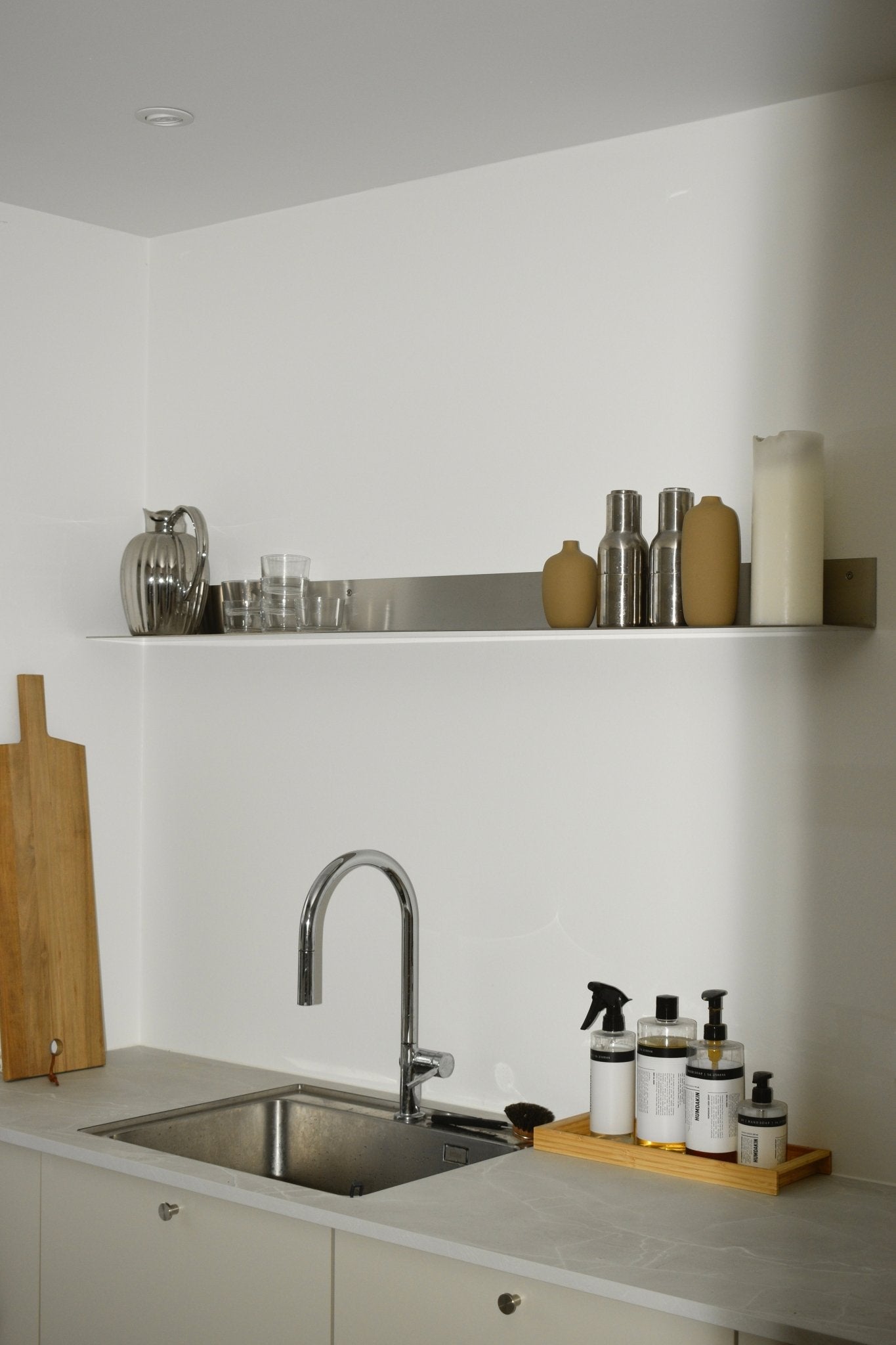
In the configuration shown, glassware and oil bottles sit forward for quick access, while a silver jug and ochre ceramic vases offer vertical punctuation. This mix demonstrates how the brush subtly echoes the chrome tap below without competing with it, and how oak boards add a necessary soft counterpoint. Keep liquids and frequently used utensils within the inner third of the shelf depth; reserves and sculptural pieces belong to the rear line. Explore finishes and specifications for the Skagen steel shelf at Acier Studio’s Skagen page.
Care, cleaning, and material longevity
Stainless steel’s chromium content forms a passive film that resists corrosion when the surface is clean and oxygen can reach it. Routine care is simple: wipe with warm water and a small amount of pH‑neutral detergent, then dry with a lint-free cloth following the grain. For fingerprints, a light application of food-safe mineral oil on a cloth can even the sheen; remove excess so dust does not cling. Avoid bleach or chloride-heavy cleaners, and never use steel wool; both can damage the passive layer. Where limescale from hard water appears near sinks, loosen with a diluted white vinegar solution, rinse thoroughly, and dry along the grain. The International Stainless Steel Forum (ISSF) provides clear guidance on cleaning practices and chloride avoidance; see their recommendations.
Danish craft and long-term value
Acier Studio fabricates in Aarhus with short supply lines and close control of finishing, which matters for brushed stainless. Consistent grain direction, precise fold radii, and clean edges are not incidental; they come from careful programming and hand finishing at the end of the line. This approach, and the traceable material sourcing behind it, is outlined in Acier Studio’s Production and materials overview.
Open steel shelves reward discipline. Their value accumulates through dependable structure, a finish that stabilises visually under daily use, and the way they negotiate between warm and cool elements without ageing out of a scheme. Well-installed stainless will outlast most countertop materials and many fixtures, and its recyclability keeps material in circulation at end of life. In practice, that means a shelf that works hard now and remains relevant as the kitchen evolves, supporting the quiet order a working space deserves.

