

Coffee table in Danish design: function, materials, and actual quality level
A coffee table must withstand daily use, relocation, and spills. In stainless steel, you get form stability, high wear resistance, and a surface that tolerates continuous cleaning. The difference in lifespan and perceived quality is determined by alloy, material thickness, and craftsmanship; here, handmade Danish production differs significantly from fast imports.
Material first: stainless steel done right
Stainless steel forms a self-healing, passive chromium oxide film when the chromium content is at least approx. 10.5%. This film provides corrosion resistance, but its effectiveness depends on the alloy and environment. According to Outokumpu, an independent material supplier, austenitic grades such as 304 are typically sufficient in dry indoor environments, while 316/316L provides an extra margin in coastal or very humid surroundings where airborne salt spray can enter the home.
The surface finish shapes practical use:
- Brushed reduces the visibility of light scratches but should be cleaned in the direction of the grain
- Polished reflects the most and requires more frequent wiping to minimize fingerprints
- Matte diffuses light and appears calm in bright living rooms with large windows
Correct post-treatment of welds, mechanical and chemical passivation, and dry maintenance significantly increase resistance over time. These steps are crucial in a coffee table's daily life, where cup rings, water droplets, and decorations continuously meet the surface.
Danish craftsmanship versus import: what differentiates them
In Aarhus, we at Acier Studio work with a focus on precision, reparability, and visual tranquility. It's not a matter of national romanticism, but of execution. Danish furniture tradition is historically rooted in material understanding and craftsmanship, as Designmuseum Danmark documents in its review of Danish Modern and post-war workshops. In practice, the difference manifests in these parameters:
- Material thickness: substantial plates and profiles for stiffness, less resonance, and even flatness
- Joints: precision welding and clean transitions, so lines remain sharp and without gaps
- Finishing: manual processing of edges and surfaces for a uniform, calm expression
- Adaptation and service: possibility for customisation, local inspection, and repair rather than replacement
This approach increases both utility and residual value. A coffee table that can be inspected and refinished avoids becoming a disposable solution.
In the room: proportion, light, and interplay
Stainless steel appears cool and light in Scandinavian interiors. It acts as a visual contrast to warm materials such as oak, walnut, leather, and natural stone. In a bright living space, a matte or brushed surface can reduce glare and support the room's architecture, whereas a high-gloss polished surface can easily dominate in direct sunlight.
Consider three factors when placing a steel coffee table:
- Proportions in plan and height in relation to the sofa's seat height and the room's clear pathways
- Visual weight of legs and under-structures, so the table appears balanced rather than an anchor in the room
- Incident light from windows; avoid the main reflection hitting primary seating areas
The trend towards airy, bright living spaces with tactile contrasts is well described in Scandinavian interior design thinking, as Nordic Nest points out in their trend overviews for 2024. In practice, this means that steel contributes tranquility and precision if the surface is balanced and the surrounding furnishings have warm textures.
Copenhagen coffee table in use: calm matte surface in a warm environment
The Copenhagen coffee table from Acier Studio is shown here in a light, matte finish in a warm, minimalist living room next to a linen-covered sofa. The surface holds a small group of dark ceramic objects and a tray, adding depth and rhythm without breaking the table's calm plane. To the left stands the Oslo pedestal with a wooden object, illustrating how cool steel and warm materials complement each other in the same composition.
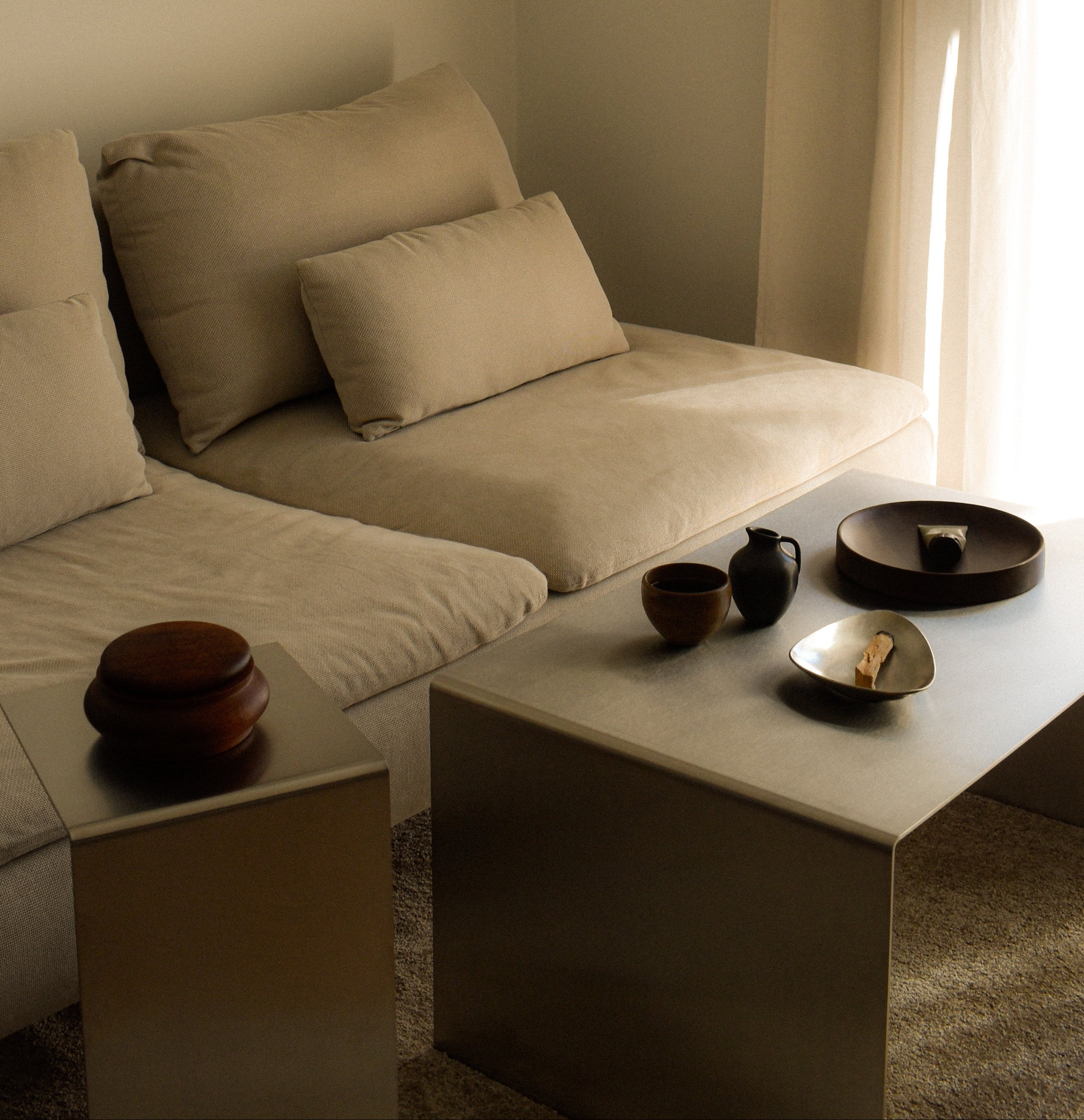
The matte surface absorbs light without sharp reflections and blends harmoniously into a neutral, earthy color palette. The interplay between the coffee table's cool tone and the dark objects creates a clear focal point, while the pedestal's higher volume adds vertical dynamics. See more about proportion and finish on the Copenhagen coffee table's product page at Acier Studio.
Mindful maintenance: how to keep the steel surface serene for years
Daily care is simple but precise. Wipe with a clean microfibre cloth, slightly dampened with lukewarm water and possibly a pH-neutral soap solution. Dry with a clean cloth, especially in hard water areas, to avoid lime scale marks. On brushed surfaces, always follow the grain direction to maintain a uniform texture. Avoid chlorine or bleach-based cleaners and acidic special agents, which can affect the passive film.
To minimize hairline scratches, felt or leather pads are recommended under ceramic and metal objects. Do not use steel wool; particles can contaminate the surface and cause discolouration. Should slight "tea-staining" occur in coastal homes, a gentle, non-abrasive stainless steel cleaner and thorough wiping can restore uniformity. In environments close to the sea, it is worth considering 316/316L or occasionally rinsing the surface with clean water to remove salt deposits, as Outokumpu points out in their corrosion guidelines.
Heat exposure from cups and dishes is rarely a problem for steel, but using coasters also protects against local scratches and dark rings from metal trays. Should a matte or brushed surface acquire a more visible scratch, controlled refinishing with a fine non-woven pad in the direction of the existing grain can often smooth out the mark. Local workshops in Aarhus can also re-passivate and refinish the item if a more thorough refresh is desired.
Finally, maintenance also includes the environment around the table. Ensure even air circulation and dry indoor conditions, especially during periods of high humidity, so that the passive film has optimal conditions.
A handmade stainless steel coffee table from a Danish manufacturer is at its core a technical solution for everyday use. Correct alloy, well-chosen surfaces, and conscientious craftsmanship provide furniture that can be refreshed, serviced, and passed down. When production is local in Aarhus, responsibility and access to expertise come with it over time. The long-term value is not only that the table lasts; it is that it can be maintained, adapted, and continue to make sense in changing spaces and generations.

