

Wall-mounted steel shelf: installation guide, load capacity and design tips
A wall-mounted steel shelf solves three specific tasks simultaneously: it provides stable weight-bearing capacity, it tolerates moisture and daily use, and it draws a precise line on the wall without dominating the room. To succeed in practice, it requires the right steel quality, a well-thought-out surface finish, as well as correct installation and load distribution.
Function and material: why stainless steel on the wall
Stainless steel forms a self-healing passive film of chromium oxide, which provides high corrosion resistance and long lifespan. The British Stainless Steel Association describes how this passive film regenerates in contact with oxygen, making the material suitable for shelves that need to withstand moisture, steam, and touch over time (British Stainless Steel Association, bssa.org.uk).
Selection of alloy:
- 304 (EN 1.4301) is a solid choice for indoor use, where the application of cleaning agents and sporadic moisture is the norm.
- 316/316L (EN 1.4401/1.4404) is recommended in coastal environments, bathrooms, and other zones with chlorides, where the risk of “teastaining” increases.
The surface roughness (Ra) affects both appearance and resistance to contamination. Finer Ra typically improves corrosion behavior; coarser Ra conceals fingerprints better but can retain dirt. Typical ranges:
- 2B cold-rolled: around Ra 0.1–0.2 µm, discreet and matte
- Satin/brushed (e.g., grit 320): around Ra 0.4–0.6 µm, low reflection with tactile depth
- Blasted/textured: often Ra 1.0–2.0 µm, soft texture, most tactile
- Mirror polished: Ra ≤ 0.1 µm, maximum smoothness, high reflection
In Scandinavian spaces, a brushed or matte surface provides calm and visual discipline. High gloss magnifies plays of light and can make small objects appear more restless than intended.
Craftsmanship from Aarhus: construction, tolerances, and finish
Small-scale handcrafted production is a quality argument, not a romantic gesture. In Danish metal workshops, joints are refined with small-batch milling, TIG welding, and manual finishing. This approach controls tolerances, edge profiles, and surface uniformity more closely than mass stamping. As Danish manufacturers and workshops demonstrate in practice, the handheld process results in sharper joints, carefully selected material thicknesses, and finishes that are consistent across the entire shelf (see, for example, the professional practice at J. L. Møllers Møbelfabrik as an example of Danish craftsmanship tradition).
At Acier Studio in Aarhus, this means, among other things:
- care in edge finishes, so touching surfaces feel dry and safe
- uniform brush pattern across the top, underside, and front edge
- precise angling, so the shelf closes completely to the wall plane
The consequence is a shelf that both reads sharply in profile and withstands close use without surface damage.
Installation guide and load capacity in practice
The shelf's load capacity is determined by the wall, the fastening, the shelf's depth, and the load distribution. The substrate is the starting point: timber frames and masonry allow for higher loads than aerated concrete or weak plasterboard.
- Find load-bearing points. In stud walls, locate studs with a reliable detector, and screw brackets into solid wood with appropriate pre-drilling. In masonry and concrete walls, use quality wall plugs or chemical anchors according to the manufacturer's instructions.
- Where studs cannot be hit, modern metal toggle anchors or snap toggles in plasterboard can provide high single anchor ratings. Choose stainless steel fasteners (A2 indoors, A4 in exposed environments) to prevent discoloration, and distribute the load over multiple fixing points.
- Think in terms of torque, not just kilograms. A deep shelf increases the torque on the wall. Keep the depth moderate for everyday use: around 180–220 mm in the kitchen for cups and glasses, up to 250 mm for books if the wall and anchors can be documented for the purpose.
- Increase the number of fixing points for long shelves, and maintain c/c distance within 400–600 mm where the wall construction allows. Use wide washers behind screw heads to distribute pressure.
- Always follow manufacturer data for anchors and screws measured specifically for your wall material. Homebuilding & Renovating emphasizes that declared load capacities only apply with correct pre-drilling, insertion, and wall thickness, and that margins are necessary for cantilevered shelves.
Place the shelf at eye level or just below to facilitate grabbing, and keep the line level. A continuous narrow shelf can draw a long wall together, while a single "floating" shelf can serve as a calm anchor point above a side table.
Skagen: slim shelf, calm surface
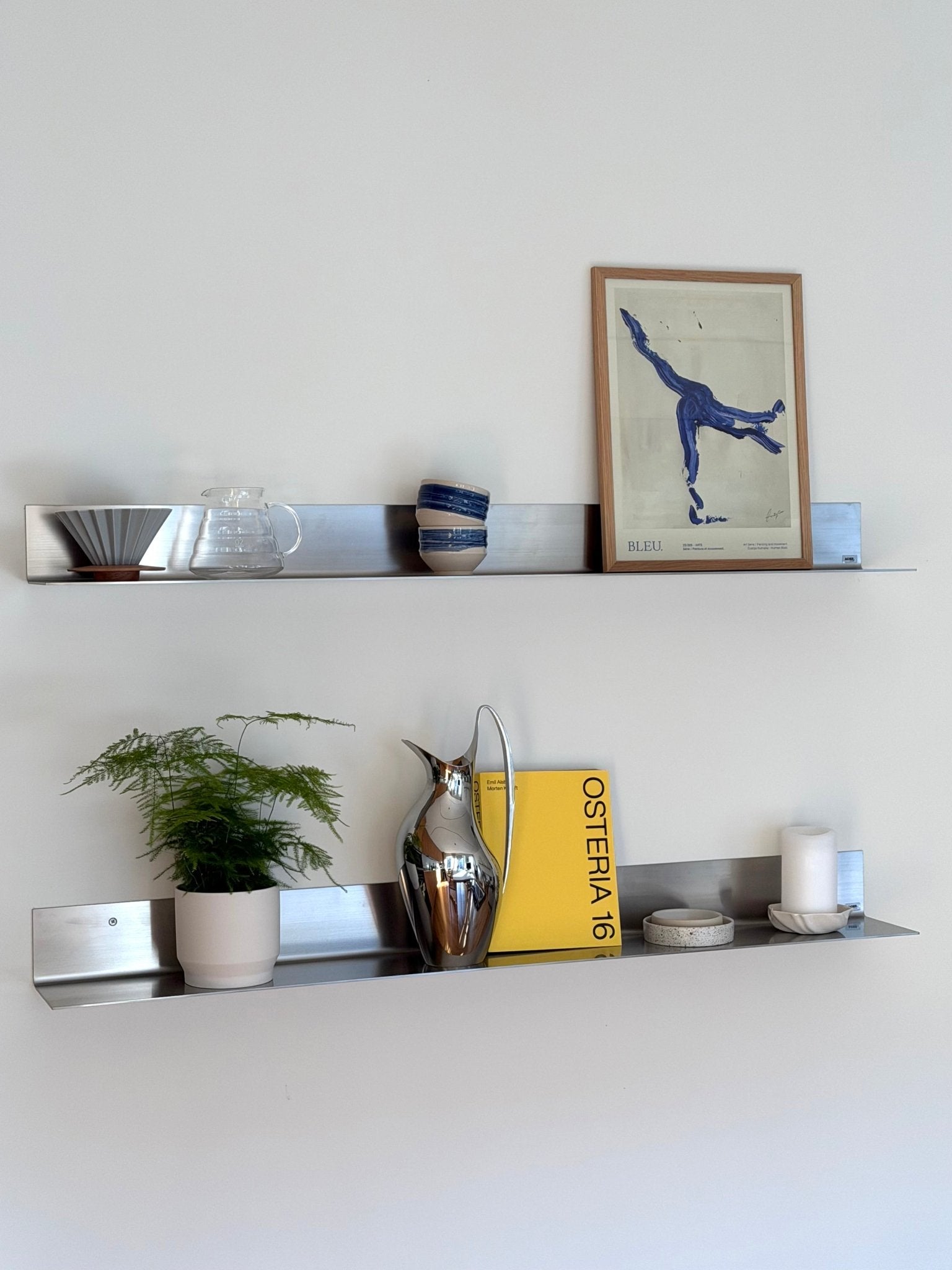
Skagen is our wall-mounted steel shelf with a slim, brushed surface that quietly blends into the wall plane. The image shows two shelves mounted horizontally on a white wall. The upper one is styled with coffee equipment and ceramics, the lower one with a potted fern, books, and small sculptural items. The combination shows that the shelf functions equally naturally in the kitchen and the living room, and that the brushed surface allows the objects to take focus.
The slim profile reads lightly from the side, while the straight line of the front keeps the arrangement disciplined. A matte, brushed finish reduces glare in strong daylight, making the shelf suitable above work surfaces and in bright rooms. See dimensions and variants for Skagen on the product page.
As 3 Days of Design often emphasizes, a balanced Scandinavian composition is created by contrasting cool metal with warm materials. Pair a brushed steel shelf with oak, paper weave, or wool textiles, and let one continuous line carry a series of a few selected objects.
Maintenance and long-term value
Stainless steel doesn't demand much, but consistent care prolongs its uniform luster. Wipe with a microfiber cloth in the direction of the brush grain. Use mild, pH-neutral dish soap in lukewarm water, rinse, and dry. Avoid chlorine-based cleaners and steel wool, which can scratch or induce flash rust. Small scratches can often be toned down with a fine abrasive pad of appropriate grit, always in line with the original brushing, and with care around edges. In coastal environments, periodic rinsing and wiping can reduce teastaining; choose 316 if the space is particularly exposed.
Long-term value in a wall-mounted steel shelf is about more than the material's durability. A precise, handcrafted profile maintains its shape, screws and anchors can be inspected and replaced, and the surface can be refreshed without losing character. With the correct alloy, documented installation, and honest maintenance, a Danish-produced steel shelf from Aarhus will deliver year after year, both as a working surface and as a calm, architectural line in the room.

