

Timeless design in the home: how to avoid trends and invest in furniture that lasts for decades
A home becomes timeless when materials, proportions, and construction are strong enough to outlast trends. Choose furniture where function and durability have been considered from the start; where surfaces are planar, edges are clean, and joints can be serviced. Stainless steel excels here, especially when combined with Danish craftsmanship and a conscious material balance.
Why stainless steel lasts for decades
Stainless steel forms a self-repairing, chromium-rich passive surface that protects against corrosion. The thin oxide film regenerates through oxidation if disturbed, which explains the material's long lifespan in interiors. According to Wikipedia, the best resistance is achieved with austenitic grades; 304 is widely used indoors, while 316/316L provides extra protection against chlorides and coastal air.
Surface treatment is as important as the alloy. A brushed satin finish hides fingerprints better than mirror, but its micro-grooves can retain fine salt deposits if the surface is not cleaned. An electropolished/passivated surface smooths the micro-topography, increases corrosion resistance, and simplifies cleaning; this practice is well-described by the manufacturer Outokumpu, who also documents the high recyclability of stainless steel in modern supply chains.
Danish craftsmanship from Aarhus, not assembly line
In Aarhus, we work small-scale and meticulously. Each piece is produced in manageable series with repeated prototypes, trial assemblies, and hand-sanding, ensuring that surfaces, folds, and joints are clean. Folded plate edges provide rigidity without over-dimensioning, TIG welds are milled down and sanded in the direction of the grain, and mechanical fasteners are placed accessibly so furniture can be serviced rather than replaced. This approach is akin to Danish workshop and guild traditions, where reparability and longevity are valued over speed; values emphasized, for example, by Københavns Snedkerlaug in their craft exhibitions.
The collection up close
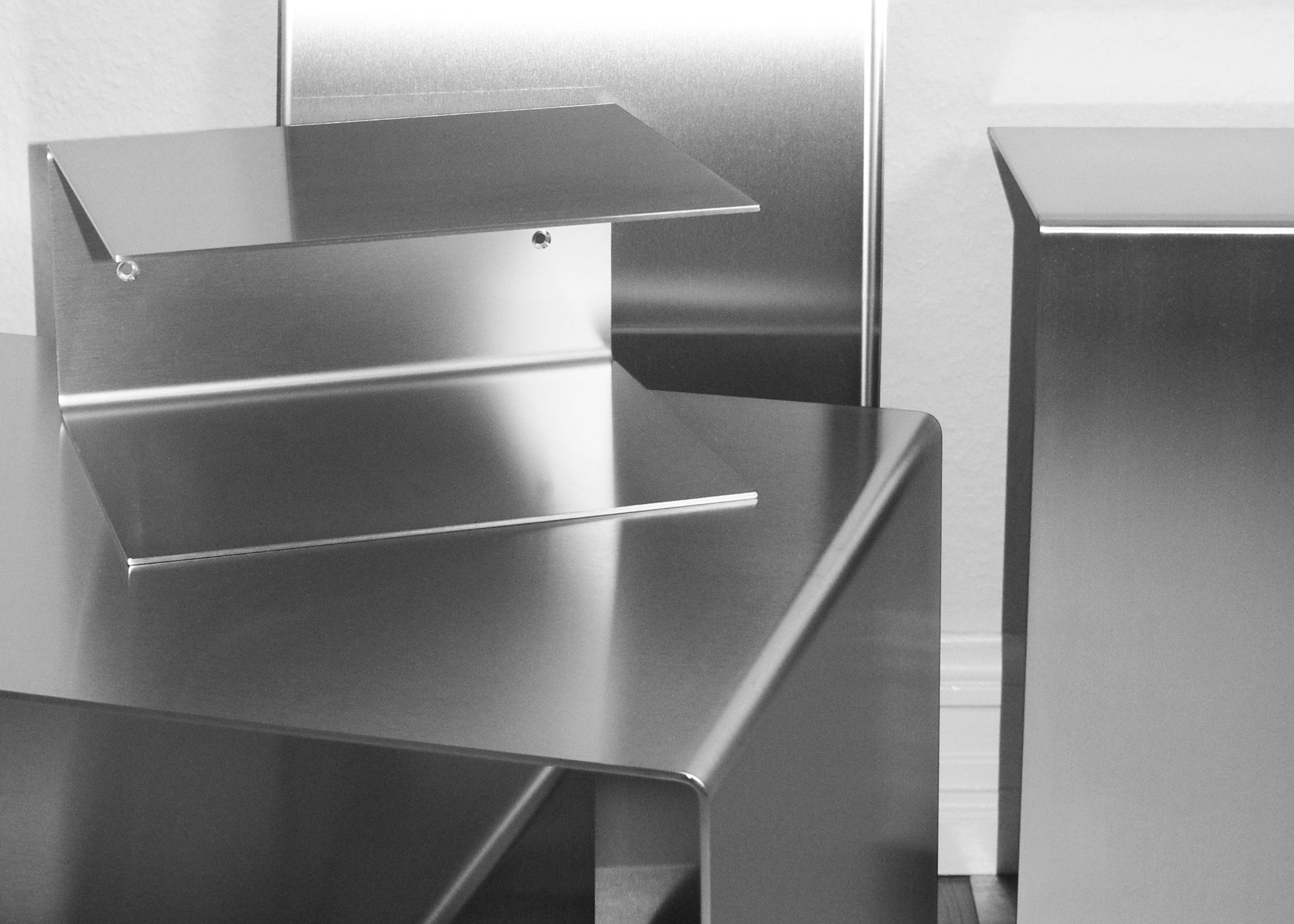
Under studio light, the collection reads as a single language: planar, unbroken surfaces, precise folds, and minimal tolerances around edges. On a low coffee table like Uppsala, the folded top forms a rigid, planar surface with subtle shadow lines along the fold; welded corners are smoothed so the grain direction is consistent all around. The visual tranquility comes from a balanced plate thickness and an exact, linear geometry that does not steal attention from the room.
The Skagen shelf demonstrates another discipline: a slender surface with a discreet setback that provides strength without visible front-facing brackets. The Oslo pedestal stands as a clear vertical with sharp edges and weight in the base, suitable for sculpture or plants. The Lund bedside table works in a compact volume, where front and sides align, and joints are recessed, so shadow gaps define the form rather than ornamentation.
See the proportions and precise folding language in our Uppsala coffee table.
Interior design and material balance in a timeless home
Stainless steel thrives when contrasted. Pair the cool, reflective surfaces with oil-treated oak or walnut, lightly honed limestone, tactile textiles, and pottery. A single warm metal like brass in small quantities can establish hierarchy in the room without the overall impression becoming trend-driven. In the current interior design conversation 2025–26, Livingetc points to textured and sanded steel in kitchens to achieve calmer reflections and more tactility, a technique that also works in living rooms and entryways. By varying textures rather than colors, one avoids trend-driven elements and maintains a clear, functional expression.
Maintenance, honesty, and longevity
Stainless steel requires less than most fear, but a bit of systematic care significantly extends its life, especially near the coast or in rooms with cleaning products that can deposit chlorides.
- Wipe regularly with microfibre in the direction of the grain; weekly for high-use surfaces
- Wash monthly with lukewarm water and pH-neutral dish soap, rinse, and dry completely to avoid water spots
- Avoid chlorine- and bleach-based agents; if spilled, rinse immediately and dry
- For “tea-stains” or initial discoloration: first clean with isopropyl alcohol, then use a citric acid-based passivation gel according to instructions, rinse thoroughly
- Small scratches in a brushed finish can be carefully smoothed with a fine, non-woven abrasive pad (e.g., 7447) in one direction
- In coastal zones: remove salt spray with fresh water regularly, especially on horizontal surfaces and in folds
- Under plant pots or soaps: use a coaster to prevent accumulated chloride-containing liquid from standing
It is honest to say that brushed surfaces develop micro-scratches with use. Over time, these blend into a uniform satin and tell the story of the furniture's life without weakening it. If you choose a suitable grade for the environment (typically 304 indoors, 316/316L near the sea), a surface that suits your everyday life, and a construction that can be serviced, you will get steel furniture with proven long-term durability and a low lifecycle footprint. Outokumpu documents that stainless steel can both incorporate a high recycled content and is fully recyclable itself, which strengthens overall sustainability when craftsmanship endures.
Long-term value in interior design comes from a few precise actions: materials with known performance, proportions that don't shout, and furniture that tolerates polishing rather than replacement. Hand-built quality stainless steel from a Danish workshop meets these criteria; it can change rooms and functions over time, maintain its structural integrity and its modest presence while the home changes around it.

