

Uppsala coffee table
Functional rationale: a dual-surface plan that reads light
A coffee table earns its place when it organises a living area without loading the room with volume. The Uppsala coffee table uses a dual-surface layout to separate everyday use from quiet storage. A slim lower shelf carries books, trays, or remotes, while the main plane stays clear for circulation and serving. Proportion and set-back are key: the lower element is smaller in plan and thinner in section, so it functions without becoming a visual block. Open sightlines underneath the top preserve legibility of rugs and floor, keeping the composition light.
Material choice: austenitic stainless for domestic use
Stainless steel suits thin profiles and precise detailing because it combines high tensile strength with reliable corrosion resistance. For interior tables, austenitic grades 304 and 316 are the usual choices. Both form a chromium-rich passive oxide film that self-heals in normal atmospheres; 316 adds molybdenum for improved resistance to chloride contamination and lowers the risk of “tea-staining” in coastal or humid rooms. Grade selection, the surface finish, and post-fabrication passivation work together to preserve appearance. Thin sections remain rigid enough for coffee-table spans while avoiding bulk, and the material’s recyclability supports responsible production.
Finish and grain direction: brushed satin, partial polish, and performance
The Uppsala is specified with a directional brushed satin that tempers reflectivity and reduces the visibility of fingerprints. Mechanically produced brushed finishes such as a #3/#4 satin establish a controlled grain; the orientation is set deliberately along long edges to reinforce the table’s lines. Brushing increases microroughness, which can make surface contamination more visible compared with bright-annealed or electropolished steel. Acier addresses this by restoring the passive layer after fabrication and by selectively polishing junctions where hands most often touch. As detailed by Euro Inox in its Guide to Stainless Steel Finishes, finish selection and post-treatment materially influence in-use corrosion performance; specifying and maintaining the correct satin grade sustains both look and function over time (Euro Inox: https://www.worldstainless.org/Files/issf/non-image-files/PDF/Euro_Inox/Finishes02_EN.pdf?utm_source=openai).
Uppsala by Acier Studio: proportions, dimensions logic, and the floating shelf
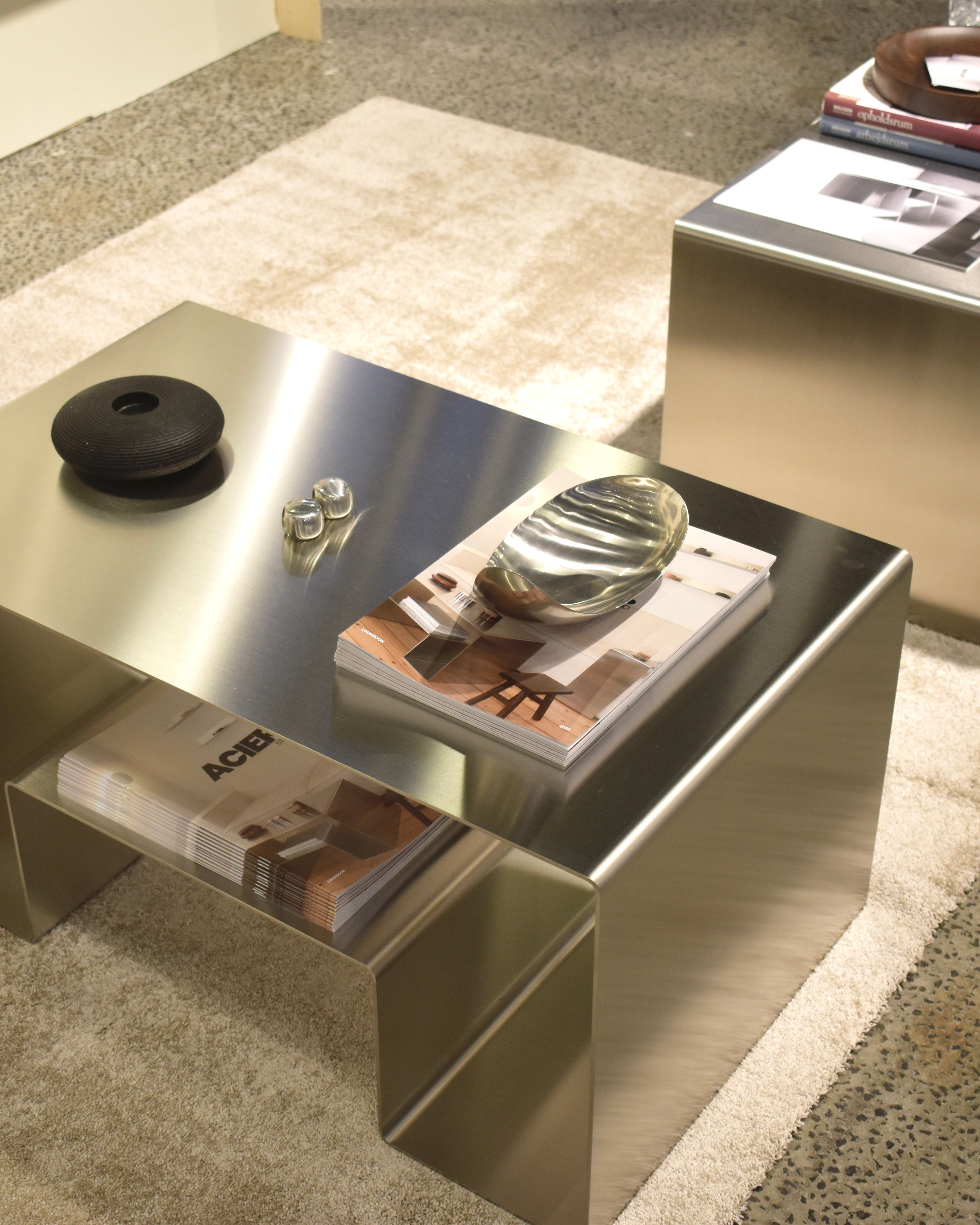
Uppsala is a low-profile rectangular coffee table in brushed stainless steel with a refined, integrated shelf. The top reads as a slim slab; edges are worked to a crisp return that strengthens the plane without thickening the profile. The shelf is recessed within the footprint and visually “floats” on fine supports set back from the perimeter, avoiding any impression of a second box within the volume.
- Height is calibrated to sit just below the average sofa seat, so trays and books are within reach without obstructing conversation lines. The lower shelf is proportioned smaller in plan, creating a continuous shadow line that reduces perceived mass.
In the studio image, the top surface carries a few objects and a slim stack of magazines, while the lower shelf holds Acier-branded issues; a second table in the background shows how repetition does not overcrowd the space when the lower element remains visually recessive. Grain direction runs lengthwise across the top, with tight, uniform striations. Junctions at the corners are jointed and dressed so the grain flows cleanly, with a subtle transition where the shelf meets the uprights. Select areas are partially polished to smooth touchpoints while keeping the field satin.
Explore specifications and available sizes on the Uppsala coffee table page: https://acier.dk/products/staal-sofabord-uppsala
Danish making in Aarhus: controlled welds, restored surfaces
Handcraft in Aarhus underpins the table’s restraint. Mitred corners are TIG welded, then hand-filed to crisp the arrises and eliminate tell-tale weld crowning. Heat tint from welding is removed before passivation so the chromium-rich film re-forms evenly. Shelf supports are jigged to maintain parallelism across the span, avoiding racking when the table is under asymmetric load. The brushed grain is aligned panel-to-panel; transitions are matched so lines read continuous rather than patchy. This chain of decisions—proportioning, fixturing, dressing, and surface restoration—distinguishes small-batch Danish production from mass-fabricated lines. For a deeper look at processes and alloy choices, see Production and materials: https://acier.dk/en-us/blogs/news/production-material
Placement and pairing: cool architecture, warm counterpoints
Brushed stainless introduces a cool, architectural register that benefits from tactility nearby. Pair Uppsala with light oak floors or a wool rug to soften the reflection, and with leather or linen upholstery to balance temperature. The lower shelf keeps remote controls and current reading visible yet quiet, reducing the scatter that often collects on a single-surface table. In compact rooms, the open underside and shelf setback keep the floor continuous; the table reads as a horizontal plane rather than a bulky volume.
Care and maintenance: preserving the satin field
Domestic stainless is low-maintenance, not maintenance-free. Routine care preserves the satin and the passive layer:
- Wipe spills promptly; use a soft microfiber cloth with warm water and a drop of pH-neutral detergent, following the grain. For fingerprints, a light mineral-oil-based stainless cleaner can even out sheen. Avoid bleach, chlorine sprays, and scouring powders, which disrupt the passive film. Do not use steel wool; it can embed carbon steel and seed rust spots. In coastal or humid interiors, periodic fresh-water wipe-downs reduce chloride accumulation. If minor tea-staining appears, treat locally with a non-abrasive stainless cleanser, then rinse and dry thoroughly. Protect floors with felt glides; avoid dragging ceramic objects directly on the shelf or top.
Long-term value
Uppsala’s utility lies in structure and surface working together: an austenitic alloy specified for interiors, a brushed finish restored after welding, and a shelf designed to add use without adding weight. The form resists trend churn because it is resolved at the level of proportion and joinery, not decoration. With measured care, the table’s grain will mellow rather than degrade, and the steel will continue to carry daily loads without deformation. In practice, that is the kind of longevity that justifies its place in a room over decades.

