

Wooden or steel wall shelf? What determines the choice in practice
The choice between a wooden wall shelf and a stainless steel shelf is largely determined by requirements for load capacity, deformation, and visual slenderness. While wood offers warmth and tactility, steel allows for very thin profiles without noticeable deflection in daily use. In rooms with high loads, long spans, or fluctuations in humidity, steel often performs most stably.
Material properties: steel versus wood
The difference begins with the elasticity and strength of the materials. Austenitic stainless steel such as 304/316 has a Young's modulus of around 190–200 GPa and yield strengths in the range of 175–300 MPa. This means that even thin steel sections remain rigid when properly formed. The Nickel Institute also describes how the passive chromium-oxide scale provides high atmospheric corrosion resistance, which is useful in kitchen zones and near windows. World Stainless / Euro Inox compile these technical data in their tables for stainless steel types.
For common furniture woods, the picture is different. The Wood Database indicates a modulus of elasticity of approximately 7–14 GPa for, for example, oak, beech, and pine. Wood is anisotropic and moisture-sensitive; it expands and contracts with seasonal variations, and its load capacity depends on grain direction and dimensions. This is not a problem in itself, but it requires thicker shelf boards or shorter spans.
In short:
- Stiffness and profile: Steel is 10–25 times stiffer than most types of wood; a steel shelf can therefore be made thin and still remain flat over longer spans.
- Moisture influence: Wood visibly moves with humidity, steel is dimensionally stable indoors.
- Surface and wear: Wood patinates and can be oiled, but easily stains and marks; stainless steel resists stains better but shows fingerprints and can be scratched with incorrect cleaning.
- Repair: Wood can be sanded and re-oiled; steel can be re-passivated and refreshed with non-abrasive agents, but deep scratches require professional treatment.
When does steel win for a wall shelf? When you want to achieve high load capacity in a narrow, discreet profile, when you want to minimize deflection over time, and when moisture or temperature fluctuations should not be reflected as movements in the shelf surface.
Aesthetics in Scandinavian spatiality
In a Scandinavian context, the encounter between steel and wood provides the desired contrast between rational calm and tactile warmth. Vogue describes how light surfaces, negative space, and discreet details carry the expression. A stainless steel wall shelf can visually recede, allowing the objects to take center stage, while a wooden shelf adds color tone and grain. If the goal is to strengthen the architecture's lines without increasing volume, the slenderness of the steel profile does the job. If the room calls for more materiality, wood is still a clear choice—possibly in combination with a steel support.
Discreet fastenings are crucial. Visible, unfinished brackets break the minimalist image. Plan installation so that lines remain clean, and let the wall be a collaborator, not an antagonist.
Skagen wall shelf in stainless steel
Skagen is our stainless steel wall shelf, developed and handcrafted in Aarhus. Its form is slim and deliberately restrained, featuring a uniform, slightly reflective brushed finish. On the wall, the eye perceives it as a thin shadow; the contents are the focus, not the shelf.
In a setup with two Skagen shelves, the distinction between functions is clear: the upper shelf holds coffee gear and ceramics, while the lower one collects books, a small fern, and sculptural objects. The image emphasizes that proportions and edge geometry can accommodate both hard and organic forms without appearing heavy in the room. The shelf thus functions equally naturally in the kitchen as in the living room, where visual tranquility is maintained even when fully in use.
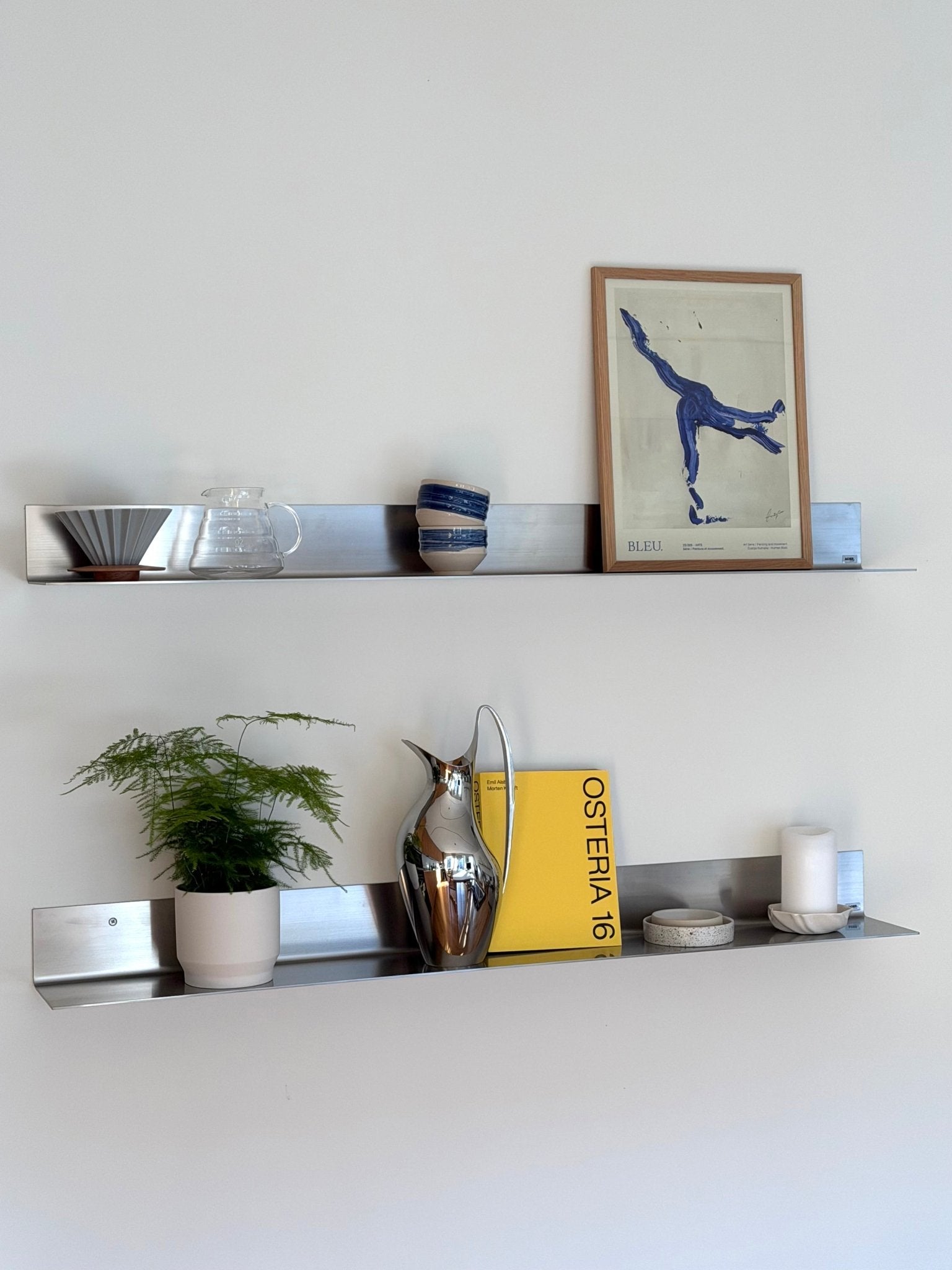
The level of detail lies in the radius of the edges, the strict tolerance setting, and the uniform grain direction. This is precisely where Danish craftsmanship makes the difference: precision in joints, even surfaces, and gentle handling throughout the process. DMK's work with the Danish craft tradition highlights how local workshops prioritize quality in material selection and finishing. For a slim steel shelf, these small deviations are crucial for the shadow effect and the perception of straight lines on the wall. See more about Skagen on our page Skagen steel shelf.
Mounting, load capacity, and dimensioning
Practical load capacity depends on three factors: material stiffness, shelf geometry, and wall construction. The theoretical advantage of steel is only realized when the load path into the wall is secure.
- For plasterboard walls, load-bearing screws should be anchored in studs or supplemented with approved hollow wall anchors. Heavy, concentrated loads like stacks of books or ceramics place higher demands on the anchor than on the shelf itself.
- In masonry, suitable plugs and the correct drill diameter must be used. A poorly drilled hole significantly reduces friction and tensile strength.
- Keep an eye on span and deflection. A simple rule of thumb is to aim for maximum deflection around L/200–L/300 for visual comfort. Since steel has a significantly higher modulus of elasticity than wood, a thin steel shelf can achieve this limit over longer spans than a correspondingly thin wooden shelf.
When the shelf is subjected to frequent movement of heavy objects, the higher surface hardness of steel will also reduce edge deformation over time compared to softer wood types.
Maintenance and long-term value
Stainless steel lasts longest when cleaned correctly. Wipe daily with a soft microfiber cloth. For grease and stains, use lukewarm water with pH-neutral soap; wipe in the direction of the grain to preserve the brushed finish. Avoid chlorine-containing agents and steel wool, which can cause tea stains or surface scratches. Fingerprints are easily removed with a non-abrasive stainless steel cleaner. For stubborn marks, a fine non-woven pad can be used lightly and consistently in the grain direction. Near hobs and in coastal homes, occasional wiping with clean water and thorough drying can prevent film and stain formation, as the Nickel Institute also describes for austenitic steel types.
Wood requires a different rhythm: oil or wax to saturate the pores, quick wiping of liquids, and periodic re-treatment. Over time, wood develops a visible patina. This is a quality in many interiors, but must be a conscious choice for a wall shelf often exposed to contact and changing loads.
Long-term value is about more than the material. It lies in precisely executed craftsmanship, well-dimensioned fittings, and the ability to service the surface. Acier Studio's production in Aarhus is based on controlled tolerances, even grinding, and repeatable assembly that can be disassembled and fine-tuned. This is in line with the approach DMK emphasizes for Danish craftsmanship: quality, reparability, and local anchoring. In a home where lines must endure and where the shelf must be able to adapt to new functions over the years, a slender steel shelf provides a robust base. Wood will continue to be obvious when material warmth outweighs maximum stiffness. Where demands for load capacity, low profile, and dimensional stability are primary, steel wins. World Stainless / Euro Inox and The Wood Database show why in the numbers; in everyday life, it is felt as fewer compromises between form and function over time.

