

Complete guide to stainless steel wall shelves: materials, placement, and selection for every room
Function first: depth, load capacity, and use
A wall shelf must serve a purpose: to stably support objects, at the correct depth, without dominating the room. Therefore, start with the load, wall type, and intended use. The depth determines what the shelf can realistically be used for; kitchen glasses require more space than small toiletries, and art books more than mugs. Load capacity depends on the quality of the brackets, the wall fastening, and the rigidity of the shelf. Stainless steel offers high strength at slender thicknesses, allowing the profile to remain light if properly braced and mounted. It is better to over-engineer the brackets than the contents.
Stainless steel and finish: what you choose and why it matters
Stainless steel corrodes slowly because the alloy forms a thin, self-repairing oxide film when there is enough chromium in the steel. As described by Outokumpu, the film forms spontaneously and protects the material from both pitting and discoloration; for indoor shelves, austenitic grades like EN 1.4301/304 and EN 1.4404/316 are the most relevant, with 316 being preferable in humid or coastal environments, while 304 is often sufficient in dry, indoor areas (see Outokumpu – What makes stainless steel corrosion resistant?).
The surface affects both appearance and maintenance:
- Choose a brushed finish for a calm, directional grain that camouflages small scratches and fingerprints.
- A mirror-like polished surface reflects light and space but requires more frequent wiping.
- An electropolished surface smooths micro-roughness and makes the steel more resistant to pitting and easier to clean, which is relevant in kitchens and bathrooms.
According to BSSA, chemical passivation and especially electropolishing can remove surface contaminants, improve corrosion resistance and hygiene; after welding, local pickling and passivation is good practice to re-establish the protective film (see BSSA – passivation & electropolishing).
Danish craftsmanship in Aarhus: construction and quality
At Acier Studio in Aarhus, wall shelves are handcrafted in small batches. This means precise cutting, controlled welding, and a consistent grinding structure, so the grain direction runs smoothly across surfaces and edges. Edges are gently rounded for a pleasant touch, and heat-affected zones are post-processed so that the whole appears technically correct and durable. This approach aligns with a Danish furniture tradition where material knowledge and refined finishing are prioritized over mass production; Designmuseum Danmark has documented this in exhibitions and archives on Danish design craftsmanship.
For wall shelves, the difference is felt in more even flatness, clean finishes, and a finish that withstands daily use without losing its expression. Small variations from handmade work are not flaws but part of the quality.
Skagen wall shelf: discreet form, clear function
Skagen is Acier Studio's stainless steel wall shelf with a slim, brushed profile that allows the contents to be the focus. Mounted horizontally on a light wall, the form recedes into the background, while the shelf provides a stable, linear surface for both display and use. The brushing is fine and uniform; the transition at the edges is smooth to the touch, and the visual thinness creates a light expression without sacrificing rigidity. In the kitchen, Skagen holds coffee utensils and ceramics; in the living room, books, plants, and sculptural objects, without the scene feeling heavy. The brackets are discreet, so the overall impression is calm and precise.
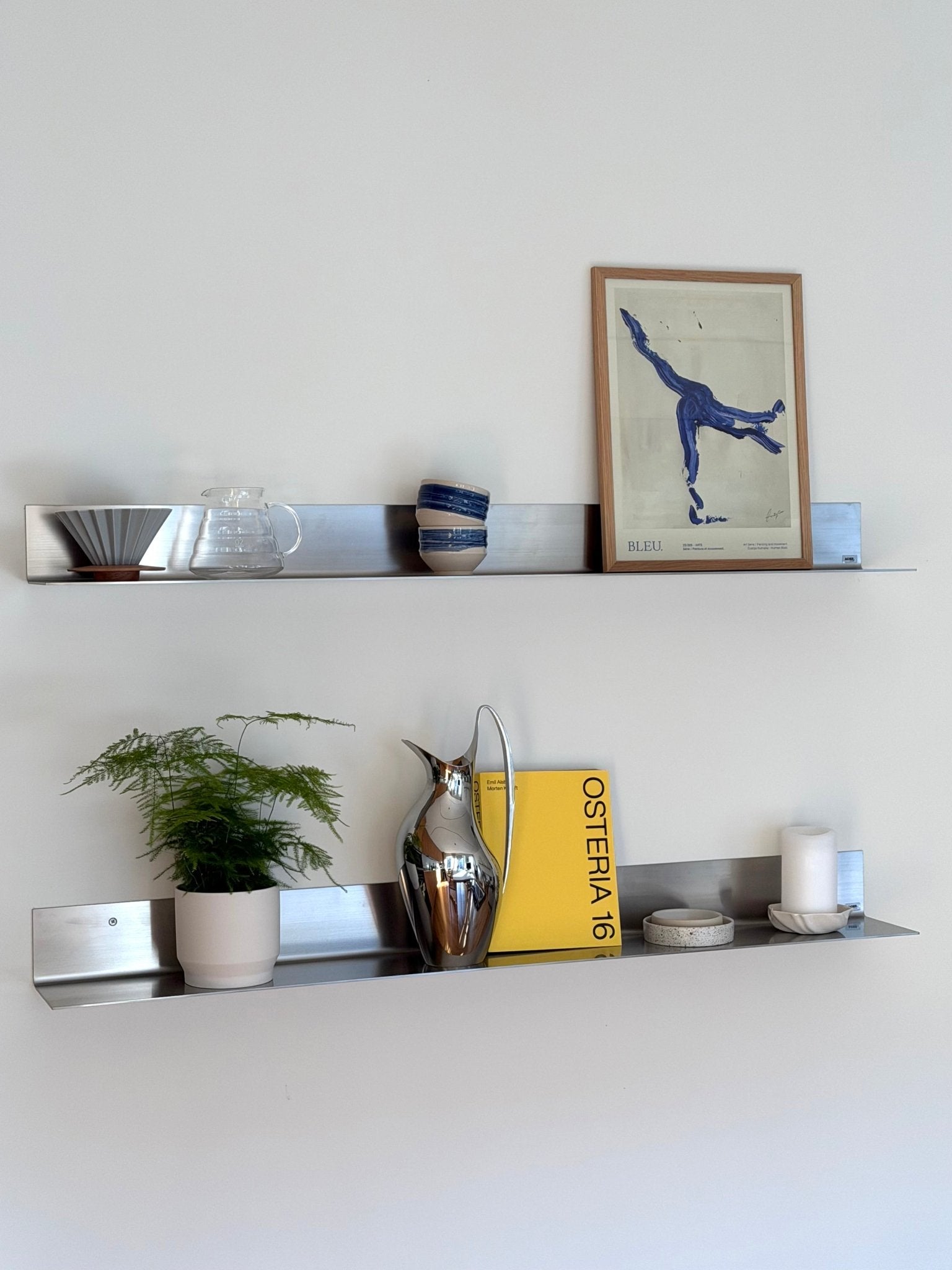
Skagen works across styles such as modern Scandinavian, industrial, and Japandi, especially when the steel is balanced with warm wood and matte stone surfaces. Scandification points precisely to the combination of metal and wood as a lasting Nordic trend that creates tactile contrast and warmth in the room (Scandification – Nordic interior trends 2026). Read more about Skagen's specifications on the product page at Acier Studio: Skagen steel shelf.
Placement, mounting, and maintenance
Correct proportions and proper fastening ensure everyday function and long life. As a practical rule of thumb for depths:
- Bathroom: 15–20 cm; avoids bumps and provides space for toiletries
- Kitchen: 20–25 cm; for glasses, mugs, and small utensils
- Living room/study: 30–40 cm; for books and larger objects
These guidelines align with sizing advice summarized by myikeabedroom.com for shelf applications in the home (see Shelf depth guide).
Mount in load-bearing material. In masonry, use appropriate plugs; in plasterboard, the shelf should be anchored to studs or with cavity anchors with documented load capacity. Off The Grain’s guide to floating shelves on plasterboard walls reviews relevant anchor types and load understanding, which is also useful for steel shelves (see Off The Grain – plasterboard guide). Avoid point loads close to the front edge of the shelf if the brackets are hidden or few; distribute the weight and respect the manufacturer's specifications.
Maintenance is simple but should be precise:
Wipe with lukewarm water and mild, pH-neutral soap. Use a soft microfiber cloth in the direction of the grain. Avoid chlorine-containing agents and steel wool, which can introduce foreign iron and scratches. Remove limescale traces in the bath with diluted vinegar, rinse, and dry thoroughly. Fingerprints on brushed steel are easily removed with a little glass cleaner or a touch of mineral oil on a cloth, followed by dry wiping. In coastal environments, tea-staining can occur; here, more frequent washing and periodic use of stainless steel-specific cleaner helps. Electropolished surfaces, as BSSA describes, will be easier to keep clean due to the smoother microstructure. After drilling and mounting, it is good practice to wipe the area for drill dust and metallic particles to avoid compromising the passive layer.
Long-term value
A stainless steel wall shelf from small-scale Danish production combines material, proportion, and craftsmanship in a way that endures technically and aesthetically. Austenitic steel can be refreshed through light polishing, and surfaces can be refinished if subjected to heavy use. The construction does not deform over time, and the shelf moves unproblematically between rooms and functions as needs change. Over the years, the investment becomes not a fashion choice, but a discreet infrastructure in the home—robust, repairable, and visually refined. When the shelf is thought through from depth to finish, it provides calm in everyday life and a stable starting point for the things that matter.
Sources in the text: Outokumpu on corrosion resistance; BSSA on passivation and electropolishing; Designmuseum Danmark on Danish craft tradition; Scandification on Nordic interior trends; myikeabedroom.com and Off The Grain on dimensions and fastening.

