

Brass Shelf in the Bathroom: Function, Material, and Maintenance
A brass shelf serves two purposes in the bathroom: it organizes daily essentials and adds warmth to cold surfaces like tiles and terrazzo. The warm tone breaks up the harsh, mineral surfaces without stealing light or taking up space in a small room. Especially above the sink or as a low-level storage shelf in the shower niche, the brass aesthetic brings calm and direction.
Warmth against Cold Surfaces: Why the Brass Look Works
The brass tone acts as a counterpoint to white, gray, or green tiles and terrazzo because it adds a controlled glow to an otherwise reflective environment. It harmonizes with chrome, brushed steel, and mirror glass, and can tie fixtures and accessories together when the color palette is kept simple. Choose a matte or brushed brass-look finish to avoid glare from spotlights; a subtle brushing mutes the light while preserving material depth.
Material Choices in Wet Rooms: Stainless Steel with a Brass Look
In humid spaces, the substrate itself is more important than the color. The warm expression of a brass shelf can be achieved with stainless steel, which forms a chromium-rich passive film that protects against corrosion. According to Outokumpu, resistance to pitting and chlorides is increased through both alloying and surface treatment. In practice, this means:
- Choose 316/316L for shelves close to the shower or in homes with hard, chloride-containing water; 304 can be used in low-stress zones if passivation and maintenance are prioritized.
- The surface should be evenly brushed or polished with low roughness. Smooth surfaces retain the passive film better and make limescale easier to remove.
The brass aesthetic is achieved without solid brass via a colored surface on the steel. Two methods are typically used:
- PVD coating in gold color on stainless steel provides a stable brass tone without classic patina. PVD is hard and durable but requires mild cleaning without chloride or acid-containing agents. D Line describes compatible cleaning agents and precautions in their Maintenance Guide for PVD Colours.
- Brass plating on steel gives a more classic look but may require more frequent polishing and careful drying to avoid discoloration in splash zones.
For bathroom shelves exposed to water and soap residue, a 316 stainless steel substrate combined with a gold-colored PVD finish is the most robust solution for a warm yet stable brass look.
Placement and Size: Simple Rules of Thumb
The shelf should be dimensioned for secure use and easy cleaning. The following measurements work in most rooms:
- Depth of 15–25 cm depends on products; 18–20 cm accommodates most bottles without visually protruding.
- Above the sink: 20–30 cm below the bottom edge of the mirror, so hands and pump bottles can be used without hitting glass or fixtures.
- In the shower niche: 90–110 cm above the floor for daily use; optionally, place an extra smaller shelf higher for rarely used products.
- Fastening: into wall studs where possible, otherwise with stainless A4 expansion anchors in solid walls. In tiled walls, pre-drill through grout lines where possible to minimize chipping risk, and use sealing washers at the brackets.
- Keep a distance from direct water spray if the finish is desired to be as low-maintenance as possible.
Product Insight: The Skagen Wall Shelf as a Reference
Skagen is our wall-mounted stainless steel shelf, developed to handle everyday function with calm, industrial precision. In a kitchen context, it shows how a brushed steel surface integrates with other materials without disrupting the overall aesthetic:
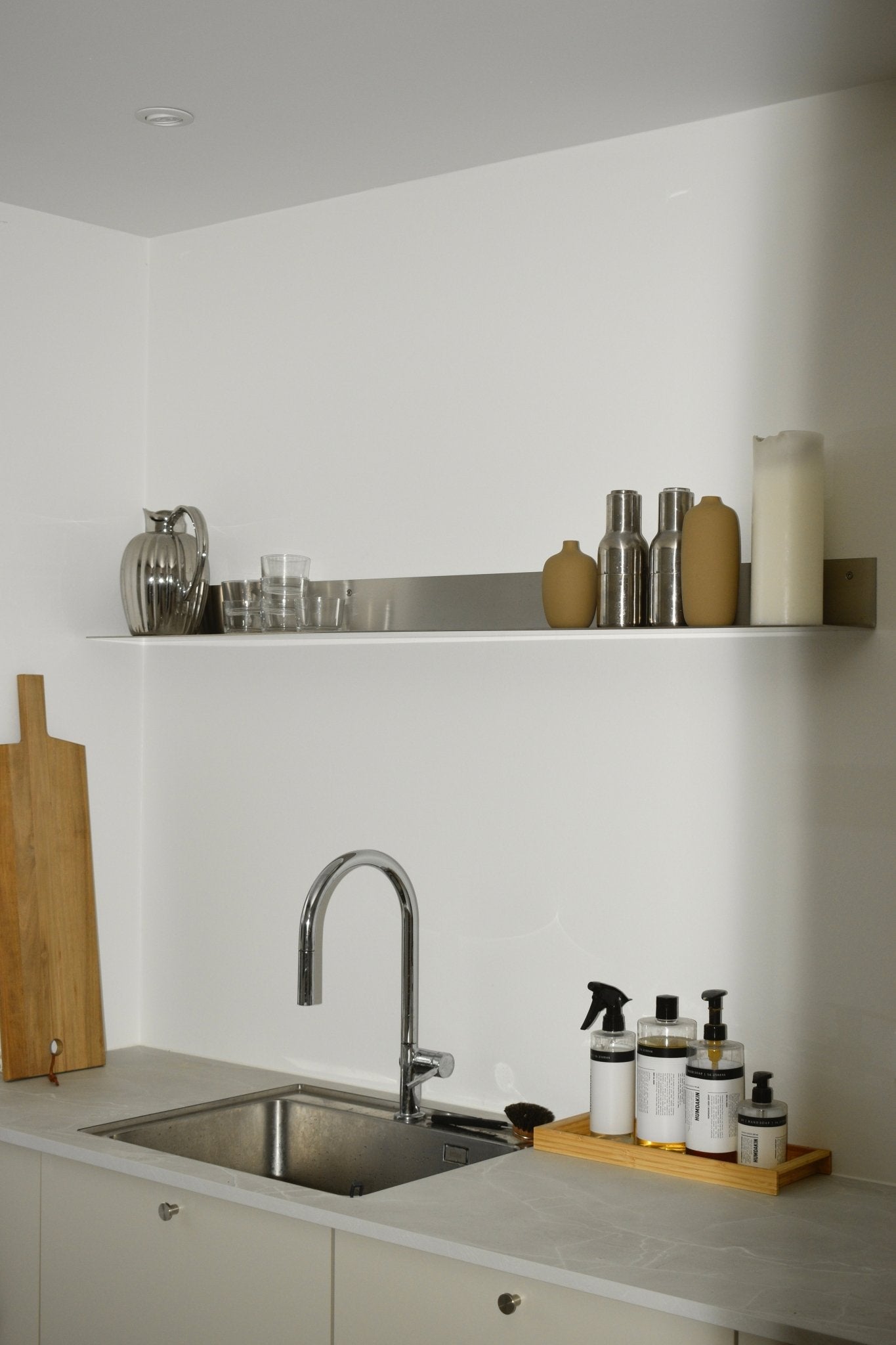
The shelf appears as a precisely bent steel plane with clean lines and an even brushing that allows objects to stand out. The slender proportions give it a light expression, but the flat geometry provides a stable resting surface. In the bathroom, the same qualities translate into a brass-look variant, where the warm tone provides a counterweight to tiles and terrazzo, while the stainless core ensures longevity in humid zones. See the Skagen in steel as a formal reference at acier.dk/products/staalhylde-skagen.
Acier Studio produces in Aarhus in small series. This allows for control over material thicknesses, precise deburring, and manual brushing, so edges feel safe in hand, and the surface is uniform throughout. Small tolerances in bends and hole patterns make mounting clean and stable; these are the kinds of details that make a shelf easy to keep neat in a wet room for many years.
Maintenance and Installation in Humid Environments
A brass-look stainless steel shelf requires limited but targeted care:
- Rinse off soap residue with lukewarm water and wipe dry with a soft microfiber cloth; limescale-laden drops are the primary cause of stains.
- Use pH-neutral dish soap if needed. Avoid chloride-containing cleaning agents, bleach, acid- and alkali-based descalers, and abrasive cleaners. This is especially true for PVD surfaces, which can be dulled by aggressive agents; D Line describes suitable agents and cloths in their PVD guide.
- For hard water, light limescale traces can be loosened with a mild vinegar solution, which should be immediately rinsed thoroughly and dried completely. Always test on an inconspicuous area.
- Small scratches in PVD cannot be polished away without changing the sheen; accept them as signs of use. On pure brushed steel without PVD, light streaks can be reduced with a fine, non-abrasive paste in the direction of the brushing.
- Use stainless A4 screws and spacers. Seal threaded holes with appropriate sealant to prevent water ingress. Gently retighten after the first few weeks, once grout and substrate have settled.
If you desire a living patina, solid brass can be chosen; however, it will require more frequent polishing, and in shower niches, darkening and watermarks cannot be avoided. For a stable, warm expression over time, stainless steel with gold-colored PVD is the most low-maintenance solution.
Perspective on Long-Term Value
When the substrate is specified correctly (316 in exposed zones) and the finish is chosen thoughtfully, a brass shelf becomes a robust tool, not a delicate effect. Danish, small-scale production in Aarhus with precise processing provides longer service intervals, the possibility of refreshing, and sensible installation economics. Over years, this means fewer replacements, a calm visual anchor in the room, and a materiality that ages gracefully instead of deteriorating.

