

Brass Shelf: Function, Material, and a Sharp Look at Alternatives
A brass shelf adds warmth and visual weight but should be evaluated based on function: load, daily contact, moisture, and cleaning. In dry living areas, the warm glow can be allowed to develop a patina. In kitchens and bathrooms, shelves require resistance to water, cleaning agents, and frequent wiping; here, the material's composition and surface are crucial for durability.
What distinguishes genuine brass from "brass-look"?
Genuine brass is a copper-zinc alloy with significant weight, good workability, and the ability to form a protective patina that adds color depth over time. This is well-documented by the Copper Development Association (Copper.org), which describes the structure and natural surface changes of alloys (see alloys.copper.org and copper.org). A solid brass shelf can be sanded, polished, and locally repaired because the material is homogeneous throughout.
“Brass-look,” on the other hand, covers several solutions:
- Zamak (zinc die-cast) with lacquer or colored coating, typically lighter in hand and dependent on the integrity of the lacquer layer
- Steel with a thin brass veneer or electrolytic coating, where wear can quickly expose the base metal at edges and contact points
- PVD coating in brass color on a steel or aluminum substrate; PVD significantly increases wear resistance, but performance depends directly on the substrate and pretreatment, as described in Heliyon via ScienceDirect (doi:10.1016/j.heliyon.2024.e35541)
In practice, the differences are apparent in weight, sound, temperature feel, and surface reaction to daily use. Solid brass tolerates repolishing and controlled patination. Coated variants rely on a thin layer; when it breaks, repair is more difficult and often visible.
When warmth meets robustness: stainless steel as an alternative
In Nordic interiors, warm metals are used as accents, but many environments require low maintenance. Here, stainless steel is relevant. Austenitic grades 304 and 316 are typically used for furniture and fixtures in homes and climate-exposed spaces because the passive, self-renewing chromium oxide film effectively protects against corrosion and wear. This passivation and practical resistance are thoroughly documented in Wiley’s Surface Innovations (doi:10.1002/srin.202300319).
From a design perspective, steel can be processed to create balanced warm expressions: a lightly brushed or satin-matte finish softly diffuses light, avoids strong reflections, and picks up shadows from wood, textiles, and stone. In living areas, it provides a calm, neutral field that allows focal points like ceramics, books, and art to stand out clearly. In the kitchen and bathroom, the material also offers robustness against moisture, cleaning agents, and frequent use, which brass rarely matches without extensive maintenance.
First Impression: Skagen Wall Shelf in Brushed Steel
Skagen is Acier Studio's stainless steel wall shelf, handcrafted in Aarhus with a slender profile and a precisely brushed backplate that captures and distributes light. In use, it functions as a discreet display edge above sofas and side tables. When two shelves are placed horizontally above a linen-covered sofa, the arrangement shows how small ceramic and stone objects find space between them, while the brushed surface creates a warm, diffused glow. The shelf visually recedes and does not compete with the room's textures and colors; it supports them.
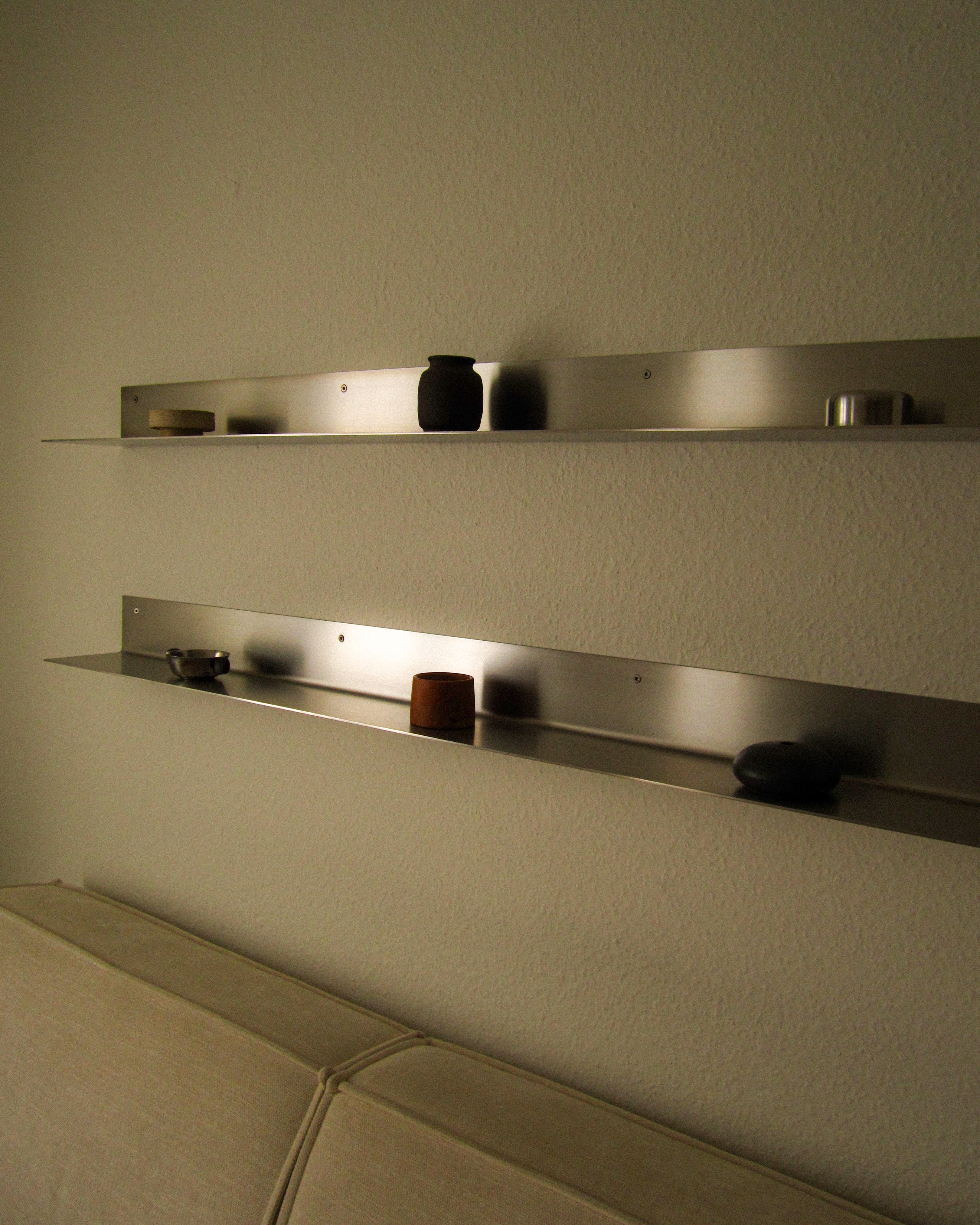
The details are clear up close: the uniform grinding direction, the firm flatness of the shelf edge, and a smooth transition between wall and shelf. The craftsmanship from the workshop in Aarhus is felt in the tolerances and in the controlled finish, which minimizes fingerprints and creates a balanced interplay with Nordic materials such as ash, oak, and wool. See more about proportions and finish on Skagen via the product link Skagen steel shelf.
Surfaces, Patina, and Maintenance in Practice
For brass shelves:
- Unlacquered solid brass will patinate. Dust with a soft microfiber cloth. For unevenness, selectively polish with a mild, ammonia-free brass paste, followed by a neutral soap solution and thorough wiping. Avoid acidic cleaners, chlorine, and abrasive agents.
- Lacquered or bronzed brass should only be wiped with a slightly damp microfiber cloth and pH-neutral dish soap. Avoid abrasive sponges. Damaged lacquer layers require professional re-lacquering or re-polishing to raw brass.
- Coated “brass-look” surfaces (electrolytic or PVD) generally only tolerate gentle cleaning. When the coating wears through on exposed edges, repair is difficult to make invisible. PVD is stronger than galvanic layers, but always follow the manufacturer's guidelines.
For stainless steel:
- Wipe with a microfiber cloth in the direction of the grain and a pH-neutral cleaner. Remove grease with a mild alcohol solution on a cloth, followed by clean water.
- Avoid steel wool, chlorine, and highly chloride-containing agents. In coastal environments or bathrooms, occasional rinsing with clean water and wiping can prevent salt accumulation. For harsh conditions, 316-grade is typically chosen; indoors in dry rooms, 304 is usually sufficient.
The material's repair possibilities should be considered in the choice. Solid brass and solid steel can be re-sanded or re-brushed if they get marks. Thin coatings can rarely be saved without replacement.
Interior Context: Warm Metals in Danish Homes
In Danish homes, brass serves as a warm contrast to light woods, limewashed walls, and creamy textiles. It can also act as a counterpoint to dark, matte surfaces, where it adds glow without overpowering the room. Formland points out that homes these days mix warm and cool metals; the choice should consider the use and climate of the room (Formland Insights no. 7, formland.dk).
In the living room and hallway, a brass shelf can hold sculptural objects and create a focal point. In the kitchen and bathroom, a stainless steel alternative is often more rational in the long run. A brushed steel shelf provides the calm, matte field that harmonizes with wood, stone, and textiles but requires far less care in damp areas. The warm experience here is created by the overall effect: lighting, material layers, and rhythm in the arrangement.
Copper Development Association (Copper.org) describes brass's natural patina as both protective and aesthetic. When combined with controlled lighting and tactile materials, the desired warmth is achieved without compromising function.
Perspective on Long-Term Value
Long-lasting interior design is about materials that can withstand use and age gracefully, and about constructions that can be serviced. Solid brass can be re-patinated and polished; stainless steel retains its structure and requires minimal care. Thin coatings can provide the right tone for a period, but rarely offer the same reparability.
For us at Acier Studio, Danish production is not a label argument, but a matter of craftsmanship, control, and verifiable geometry. When welding, grinding, and assembly are brought together in Aarhus, we can control tolerances, surface quality, and fit to wall and fixtures. This provides peace of mind in use and a more predictable aging process. Ultimately, that's what makes a shelf—whether it expresses itself warmly like brass or soberly like steel—a piece of furniture that deserves its place year after year.

