

Home Office Desk: Size, Material, and Price — and When Steel Makes Sense
The Right Size for the Job
A functional home office starts with the depth of the desktop. Plan for 60–80 cm; 60 cm is sufficient for a laptop with an external monitor, while 70–80 cm provides comfortable space for a larger monitor, keyboard, and note-taking. The width depends on the task: 120–140 cm is a good starting point for a single person's daily work, while 160–180 cm allows for dual monitors or side projects without creating visual clutter. Ensure 70–75 cm of free knee height and a sitting height of approximately 72–74 cm for most standard chairs. Cable management should be considered from the outset with a back edge, tray, or discreet routing through the desktop, so wires don't interfere with drawers or walls.
The brightness of the surface also plays a role. In smaller rooms, a satin or brushed finish can reduce glare from windows and screens. At the same time, steel's ability to reflect light can brighten a narrow room if balanced with textiles and wood. The practical prioritization of depth, light, and order aligns with the interior design principles described in Innes' Scandinavian Home Office Guide (Innes).
Materials and Finish: Thoughtful Selection of Stainless Steel
For an indoor desk, austenitic grades such as 304/304L are the balanced choice. They combine formability, weldability, and good general corrosion resistance for daily use. If your home is near the coast, or if you have persistent chloride exposure (for example, chlorine-containing cleaning agents or salty air), 316/316L is a sensible upgrade. Outokumpu describes 304/1.4301 as a robust "workhorse" in interiors, delivering stable performance without unnecessary alloying in neutral environments (Outokumpu — Forta 304/1.4301).
Finish controls both expression and maintenance:
- Choose a uniform, longitudinal satin or brushed finish for low glare and less visible minor scratches.
- A mirror-polished surface reflects more and reveals fingerprints faster; it is best suited where visual enhancement outweighs practicality.
- A blasted, matte bead-blasted texture feels warm to the touch but requires regular wiping to maintain its velvety-matte character.
Powder-coated or PVD-treated steel parts reduce fingerprints and stains, while chemical passivation after processing rebuilds the protective oxide film. This detail makes a long-term difference in a home environment with coffee, tea, and skin oils.
Steel works particularly well as a slim frame or legs, possibly with a tabletop in oak, leather, or honed stone for tactile balance. The combination creates a visually light desk that still feels solid.
Craftsmanship in Aarhus: Why Danish Production Pays Off
Danish workshops work in small batches with tight tolerances, hand polishing, and integrated woodworking when steel meets wood or leather. Welds are adjusted, blended, and finished by hand to honor the "truth" of the material rather than hiding it under thick paint. This approach prioritizes longevity, repair, and replaceable parts over lightweight and thin profiles that push boundaries. Designmuseum Danmark highlights, among others, Poul Kjærholm for establishing steel as a legitimate, sculptural furniture material in Danish design tradition, which continues to influence our material choices and prototyping culture today (Designmuseum Danmark).
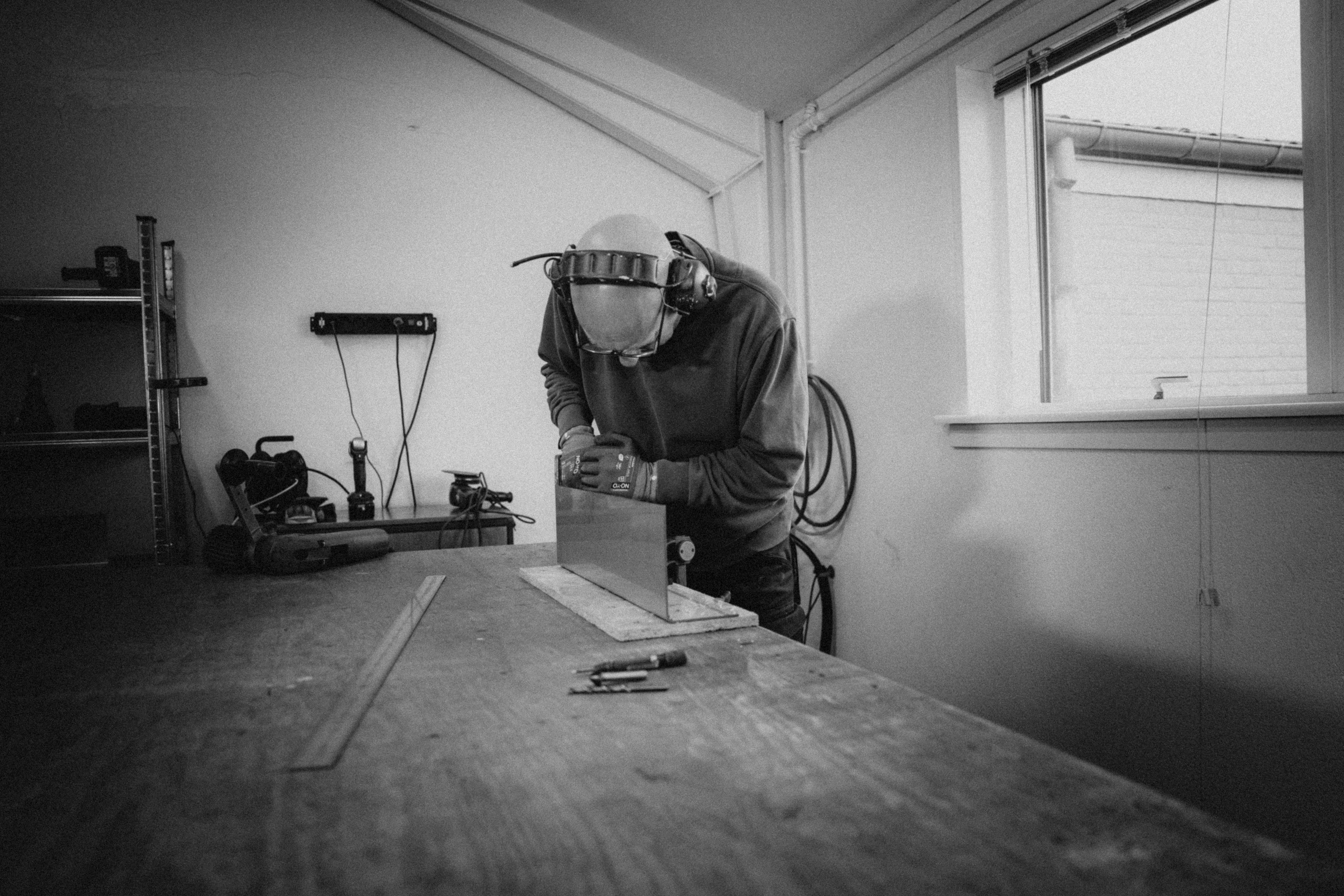
A concrete example from our own production is the Bergen steel shelf, where the same handling of grinding patterns, corners, and weld seams is used when we build desk frames. A consistent, directional brushing on all visible surfaces, rounded edges for better tactility, and hand-blended TIG seams at transitions provide calm light and a calm shadow profile. This methodology is transferred one-to-one to legs, aprons, and cable trays in desks, so the whole appears balanced and technically precise. Read more about our approach on the Production and materials page.
Specification and Maintenance: What Extends Lifespan
When comparing price and quality, ensure the following are described in writing:
- Steel grade (304/304L vs. 316/316L), finish, and grain direction
- Material thickness in sheet or profile (consistent rigidity requires sufficient material)
- Whether welds are hand-blended and post-polished on visible surfaces
- Passivation after processing, as well as edge hardening or sealing at cutouts and openings
- Details for cable routing, removable trays, and felt/insulation spacers against wood to prevent discoloration
- For warranty: how scratches, repainting, and repolishing are handled
Maintenance is simple but requires consistency. Wipe weekly with a soft microfiber cloth and lukewarm water with neutral dish soap. Avoid chloride-containing cleaning agents and bleach. Use isopropyl alcohol for greasy fingerprints, and lightly polish with a fine, non-woven abrasive sponge in the direction of the grind if minor scratches bother you. For pots, lamps, or sharp metal feet, felt or protective rings are recommended. PVD and powder-coated surfaces should also be cleaned gently; avoid abrasive scouring pads. In homes near the coast, it is sensible to inspect more frequently and choose 316/316L from the start.
Perspective on Long-Term Value
A stainless steel desk from a Danish workshop costs more than a mass-produced solution, but the value lies in dimensional stability, predictable patination, and the ability to service and refresh surfaces in five or ten years rather than replacing the entire piece of furniture. When specification, finish, and maintenance are well thought out, the steel becomes a calm, lasting anchor in the home office that can withstand changing work styles and decor without losing precision or character.

